
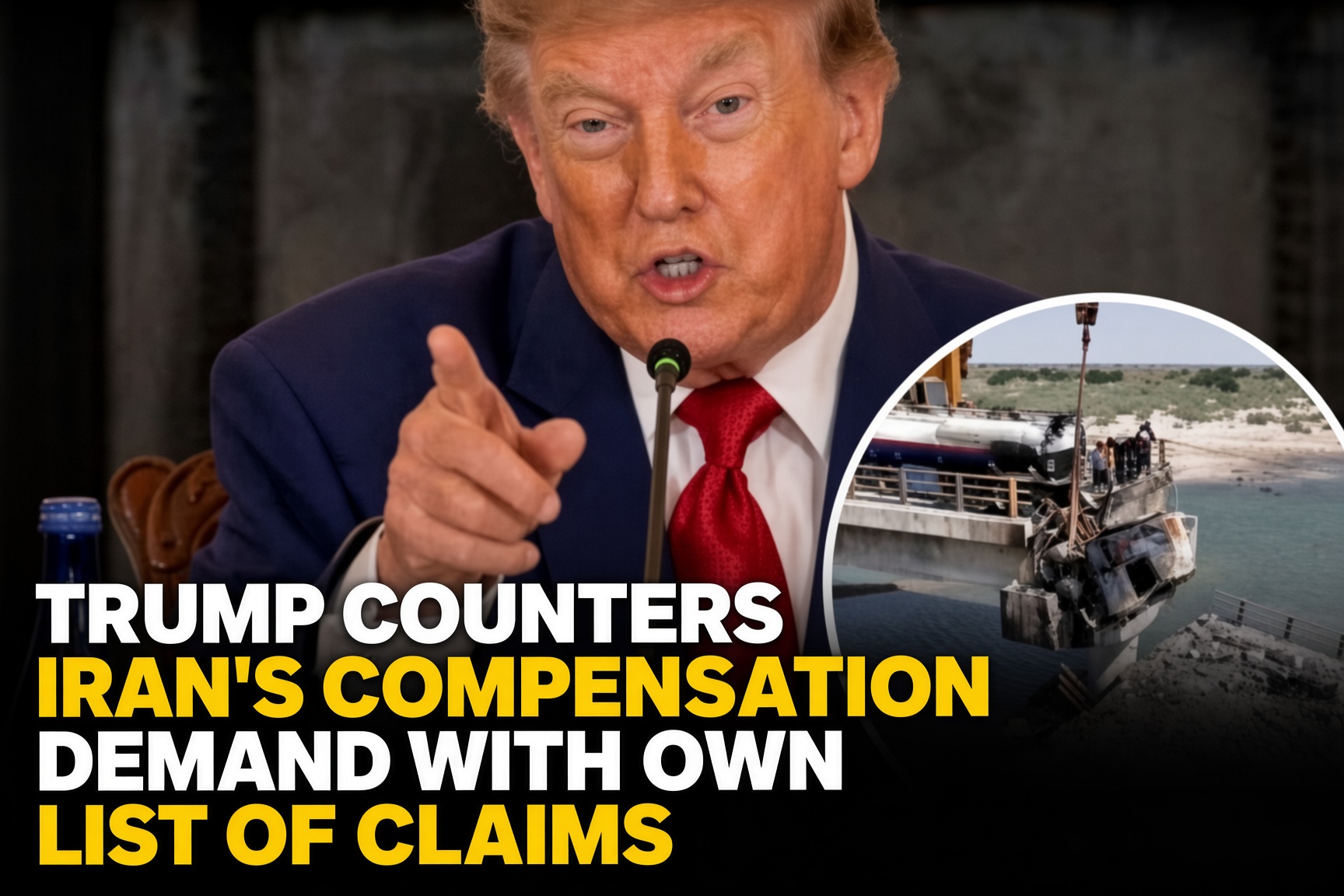
WASHINGTON – President Donald Trump on Monday rejected Iran’s call for war reparations as a condition for reopening the Strait of Hormuz, responding with a sweeping counter-demand that Tehran compensate victims of Iranian-backed attacks and domestic repression going back decades. Iranian officials had signaled over the weekend that the strategic waterway would remain restricted until the United States paid for damage inflicted during the five-month conflict. Trump addressed the demand directly in a Truth Social post, noting that compensation had never been raised in previous negotiations.
“I see that Representatives of the Islamic Republic of Iran are asking for compensation for the damage done to them during the last five month Military Conflict (started because, THEY WILL NOT HAVE A NUCLEAR WEAPON), even though it was never mentioned in any of our negotiations or meetings!” Trump wrote. He then turned the request around. “But it is an interesting idea because now I am likewise demanding compensation from Iran, for all of the people that they have killed and gravely wounded with their roadside bombs and many conflicts, for which they are famous, as led initially by General Soleimani, including the families of those killed on the USS Cole, and thousands of others killed in combat.”
Trump expanded the scope further, calling for payments to the families of “the hundreds of thousands of innocent protestors that Iran has killed over the last 50 years, not to mention the 52,000 that have been killed in the last five months.” He said he had instructed U.S. negotiators to include the compensation demand in all future talks with Tehran.
Hardening Positions Over Strait Access
The exchange marks a hardening of positions as hopes for a near-term agreement to restore free passage through the Strait of Hormuz have faded. The waterway remains a critical chokepoint for global energy supplies, and prolonged restrictions have contributed to recent volatility in oil markets. Iran has tied the full reopening of the strait to a package of U.S. concessions that includes lifting sanctions, ending the naval blockade of Iranian ports, releasing frozen assets, and paying reparations for war damage. Those conditions largely track elements of a June memorandum of understanding that collapsed within weeks.
Trump’s response introduces a new and expansive set of claims that analysts say are highly unlikely to be accepted by Tehran. By citing historical incidents, including the 2000 attack on the USS Cole and casualties linked to the late Quds Force commander Qasem Soleimani, as well as domestic Iranian protest deaths, the president framed the compensation issue as reciprocal rather than one-sided.
Negotiations at Impasse
The latest rhetorical escalation comes amid ongoing uncertainty over the trajectory of negotiations. While both sides have at times suggested progress is possible, the addition of mutually rejected financial demands has further complicated efforts to stabilize the situation and restore normal commercial shipping through one of the world’s most important maritime corridors. U.S. officials have not publicly detailed how any compensation claims would be calculated or enforced. Iranian officials, for their part, have continued to insist that hostile actions must end before the conditions for safe passage through the strait can be guaranteed.